Claude Debussy: Piano Music, Vol. 3
Roy Howat continues his survey of Claude Debussy's piano music, eventually to occupy four CDs. Book 1 of the Préludes is the main offering, and Howat's performances allow us to hear these pieces in a new light.
Most excitingly, this volume contains a world premiere recording of a work discovered in Paris in late 2001.
Other volumes in this series:
Vol. 1 – Images and Études (TP094)
Reviews
Is there a right way of playing a composer's music? Roy Howat has a magnificent track record as a French music scholar, and as a stylist in its interpretation (Chabrier as well as Debussy). Pieces of Debussy are still being discovered, not least by Howat himself, and this disc has a musicological highlight, a first recording of Debussy's tribute to his coalman, whose generosity kept him warm in the winter of 1916-7. Howat's playing is intentionally faithful, admirably clear and intellectually transparent in his interpretations.
But if we listen to a great pianist play Debussy – say Michelangeli, Richter, or Gieseking – we equally hear the music work not only as impressionism but also pianism. Maybe fireworks, maybe poetry. When, in that famous phrase, we hear that the piano no longer has hammers it is not because of some careful stylistic respect, but because the master pianist is a magician of the sound-world. We are exalted in ways that Howat, sadly, does not come near. Perhaps, as a performer, Debussy himself could not achieve this, but his interpreters must strive to.
The penultimate instalment in Roy Howat's traversal of Debussy's complete piano works reinforces the strong impressions made by his previous recordings, especially of the Etudes (TP094) and the Préludes Book 2 (TP123). In many ways he is an ideal Debussy interpreter, for he has immersed himself in the style both as a performer and as a scholar. His playing, like his writing, is clear, direct, sensitive to nuance, and often touched with humour. His interpretations are born from within the score, never imposed from the outside. He has the gift to say things simply and quietly–which is not an absence of interpretation but rather the most subtle and highest form of it. His control of low-end dynamics is particularly impressive: for once we hear the four-voiced texture at bars 63-66 in 'La danse de Puck', just the right amount of clarity at the end of 'La cathédrale engloutie', and some ethereal left-hand staccatos in the Toccata from Pour le piano. His pedaling always reflects a keen ear for texture as well as attention to the durations of Debussy's bass notes. The interpretation of Estampes is exemplary in all these ways, one of the finest accounts I know, with the last two pages of 'Pagodes' utterly magical in effect.
Listeners will be surprised by some of Howat's tempos in the Préludes, for we have become accustomed to slower ones from Michelangeli, Jacobs, Cassard, and Thibaudet, to name a few. Certainly there is little sense of langueur in Howat's accounts of 'Danseuses de Delphes', 'Les sons et les parfums tournent dans l'air du soir', and 'La fille aux cheveux de lin'. But Debussy prescribed metronome indications for these pieces, and in each one Howat's tempo proves to be right on the mark. The fact that Debussy abandoned the use of metronome markings in his later works does not mean that he necessarily decided they were wrong in these instances. In any case, Howat's accounts act as welcome correctives. In 'La cathédrale engloutie' and 'Minstrels', which lack metronome indications, Howat's tempos seem perfect–the former slightly faster than usual, the latter slightly slower.
Howat's cultivated wit is especially in evidence in the shorter pieces that round out the disc. And a delightful bonus is the first recording of 'Les soirs illuminés par l'ardeur du charbon', a recently discovered work composed in 1917 that contains allusions to several earlier pieces. Debussy dedicated it to his (apparently musical) coal merchant, who helped him get through a hard wartime winter!
If you are seriously interested in Debussy and his piano music, get these CDs (there are four of them) from Tall Poppies and make up your own mind about these opposed responses and tell Musical Pointers?
The issue raised by their contrast is also tackled in an absorbing novel about the pianist's life, frustrations and triumph, Conrad Williams' The Concert Pianist, in a section in which the two attitudes are set beside each other: – – the modernist view that if you do what the music says and play with stylistic accuracy the music will speak for itself; and the contrary view that what makes a performance work is an insight into something not manifest in the score [The Concert Pianist, p. 145]
Artists

Roy Howat
Roy Howat’s Debussy is clear, rhythmically alert and free of romantic haze. Across four volumes of the complete piano music, scholar and pianist meet: humour surfaces, textures stay polyphonic, and the score speaks without varnish.
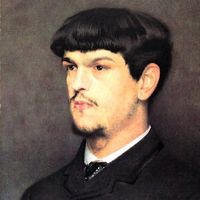
Claude Debussy
Claude Debussy (1862–1918) was a French composer whose harmony, colour and flexible sense of key reshaped European music at the turn of the twentieth century. Piano, orchestral and chamber works from his maturity remain central to the repertoire.
Tracks
- Morceau de concours Claude Debussy :54
- Pagodes 4:54
- La soirée dans Grenade 4:46
- Jardins sous la pluie 4:05
- Danseuses de Delphes 2:41
- Voiles 3:13
- Le vent dans la plaine 2:14
- "Les sons et les parfums tournent dans l'air du soir" 2:38
- Les collines d'Anacapri 3:02
- Des pas sur la neige 4:03
- Ce qu'a vu le vent d'Ouest 3:40
- La fille aux cheveux de lin 2:03
- La sérénade interrompue 2:41
- La cathédrale engloutie 5:25
- La danse de Puck 2:48
- Minstrels 2:39
- Les soirs illuminés par l'ardeur du charbon (1917 – première recording) Claude Debussy 1:56
- The little Nigar Claude Debussy 1:26
- Hommage à Haydn Claude Debussy 2:09
- Prélude 4:35
- Sarabande 4:20
- Toccata 4:34
- La plus que lente Claude Debussy 3:49
Estampes Claude Debussy
Préludes Book 1 Claude Debussy
Pour le piano Claude Debussy
Performers
- Roy Howat · piano
Contributors
Liner notes translation
Anne Penesco
Piano technician
Darrell Moulton
Cover artwork
Lisajane Bakti-Braun
Piano technician
Ron Overs
Liner notes
Roy Howat
Roy Howat’s Debussy is clear, rhythmically alert and free of romantic haze. Across four volumes of the complete piano music, scholar and pianist meet: humour surfaces, textures stay polyphonic, and the score speaks without varnish.
Where to listen
Claude Debussy: Piano Music, Vol. 3 is available for streaming through Apple Music. It can also be purchased through the iTunes Music Store.
Claude Debussy: Piano Music, Vol. 3 is available as a CD. It can be purchased online through Buywell Music or the Australian Music Centre which both offer online ordering.
Product details
- Catalogue number
- TP164
- Total playing time
- 74 minutes 35 seconds
- Producer
- Belinda Webster
Toni Castells - Recording Engineer
- Belinda Webster
Toni Castells - Venue
- ABC Studios, Sydney
Royal College of Music, London - Credit
- Anne Penesco
Darrell Moulton
Lisajane Bakti-Braun
Ron Overs
Roy Howat - Release date
- 23 May 2002
- Label
- Tall Poppies
- Musical work
copyright - © 2002 Tall Poppies Records
- Sound recording
copyright - ℗ 2002 Tall Poppies Records
- Category
- Modern Masterpieces
- Genre
- Romantic & Impressionist
- Barcode
- EAN 9399001001644
Related recordings

Le Tango Perpetuel
Ian Munro, superb pianist and imaginative composer, turns piano masterworks into chamber colour for the Australia Ensemble. The disc also preserves a rare late performance by tenor Gerald English in Satie’s Sports et Divertissements.

Barber & Debussy
David Berlin’s debut recital gathers gems of the 20th-century cello repertoire. The Barber and Debussy sonatas stand among the instrument’s masterpieces, while Bloch, Falla and Granados complete a programme long favoured in the recital room.

Cafe Fiddle
After the success of his Tall Poppies Brahms sonatas with Milton Kaye, Australian violinist Ben Breen reunited with the veteran pianist for a second disc. Recorded near the end of Kaye’s life, it became the last chapter in the accompanist’s long recording career.
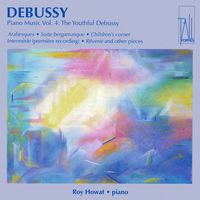
Claude Debussy: Piano Music, Vol. 4
This is the fourth and final disc in Roy Howat’s complete Claude Debussy piano music. The major works are the Arabesques, Suite bergamasque and Children's Corner, with early pieces and a world-premiere Intermède.
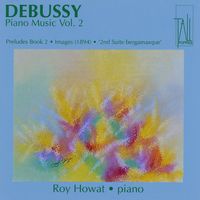
Claude Debussy: Piano Music, Vol. 2
Roy Howat continues his four-volume Debussy survey with Préludes Book 2, the early Images of 1894, wartime pieces and an unofficial second Suite bergamasque.

Romancing the Oboe
Oboist David Nuttall and guitarist Timothy Kain turn romantic miniatures into a warm chamber programme. Familiar favourites sit beside Brazilian sambas and Nielsen’s incidental music.