Meditation
The Grand Organ in Sydney Town Hall is a vast romantic instrument, the largest in the Southern Hemisphere. It might seem an unlikely choice for this ethereal French music, among the greatest ever written for the organ, yet in the right hands it reveals many subtleties.
Organists around Australia have been struck by the veracity of the recorded sound, and by the many colours of the music itself, from the slightest whisper to thundering full organ with its raging 64-foot stops underpinning the drama.
Recorded on the 1890 Hill organ in 1994, the programme spans Messiaen's organ writing from the late 1920s to 1960, from the hushed Le Banquet céleste to the complete L'Ascension and the Pentecost Sortie.
Reviews
David Rumsey's single-CD selection from Messiaen's oeuvre makes a neat traversal of what is available (some seven CDs' worth, were he to record it all) and, just as importantly, forms a very satisfying 'recital' program. It sets out with a beautifully-paced reading of Apparition de l'église éternelle in which the rather relentless rhythmic tread of the music leads to an impressive climax and gradual dissipation. It's as though the organ itself is slowly and lop-sidedly marching past our ears and on into the distance. This is followed by the slowest performance of Le Banquet céleste I have ever heard (10 minutes, compared to less than seven-and-a-half in the composer's own recording).
Rumsey's recital itself reaches its climax in the penultimate 'Transports de joie' movement from L'Ascension, followed by its concluding meditative 'Prayer' and then the 'Sortie' ('recessional') from the Mass of the Pentecost, so that listening to the 77 minutes from start to finish is a particularly rewarding experience. The recording, of the Hill organ in Sydney Town Hall, is spotless, Rumsey's own program notes are informative, and the cover painting is splendid, Janet Bodaan's 'The Silent Cathedral' – the image is of a vaulted forest roof – understatedly uniting Messiaen's Christianity and his love of birdsong.
Since the advent of the compact disc, a few digital recordings have now been made of the Hill & Son organ of 1890 in the Sydney Town Hall. All these recordings have been "crowd-pleasers" with transcriptions and popular organ works destined for the "man in the street". (Don't get me wrong: there is nothing wrong with this and it is very important to have such recordings available to the general public). What has been seriously lacking over the century plus that the organ has existed, is a serious recording devoted to some of the greatest organ music ever written, played on one of the greatest organs in the world.
While some readers may still not appreciate the sheer genius of Olivier Messiaen, to devote a whole CD to his music is a recording triumph. David Rumsey is to be congratulated, as is Belinda Webster from Tall Poppies, for having the initiative to produce this CD.
The CD booklet's cover is totally appropriate for this music. It features a print of Janet Bodaan's painting The Silent Cathedral. One feels as if one is standing in a forest looking up at the tree tops with the sunlight filtering through the forest canopy to form a giant, natural cathedral. How appropriate for Messiaen with the elements of light, colour, nature (the birds), creation, timelessness and the church all captured in this one image.
The booklet contains program notes on all the pieces played, notes on the player, but only two lines about the organ: "Pneumatic action organ by Hill of England, 1890. 5 manuals (Great, Swell, Choir, Solo, Echo) and Pedals. 126 speaking stops, 14 couplers."
The recording quality is excellent and I know of many who have heard this disc and have compared it to the others, who believe this is the best sound recording of the Town Hall organ yet.
The program is what many would consider to be Messiaen's most popular works for the organ; three are self contained pieces, two are movements from larger works and one is a complete work in itself, containing four movements. So how does the Hill organ manage the music of Messiaen when it has no mutations in its specification? Remarkably well! The Apparition is a recording feat in itself in that the piece begins so softly and builds up to full organ and ends so softly. This is one of the highlights of the disc for many as the climax of the piece occurs with huge C major chords on full organ with double octaves in the pedal making use of the 64' pedal reed for several bars.
The Verset features many of the soft solo colours, some of which many never have been recorded previously. The Banquet céleste is interesting in that it requires specific mutations in the Pedal. Some compromise had to be made, and I must say that the first time I heard it, I thought there was something wrong with the first chord. The second chord didn't seem quite so bad, but by the third chord, the piece seemed perfectly natural, as if this was the way Messiaen had always intended it to sound.
For me, one of the greatest moments in the organ repertoire is the last section of the second movement of L'Ascension, surely inspired by the In Paradisum from Fauré's Requiem. Here Messiaen asks for Recit Céleste, Gamba, Flute et Bourdon for the left hand, GO Bourdon for the right hand and Pos. Prestant 4, Flute 4, Piccolo 1 coupled to the Ped. Flute 4 for the Pedal. In this recording we hear what sounds like the left hand playing on the Positive registration which is also coupled to the Pedal, instead of on the Recit 8's. While it does sound effective, it is quite different from what Messiaen originally intended and I wonder if it was an error in registration, as it isn't set out clearly on the score and could have been easily misinterpreted.
My only other criticisms on what is otherwise perhaps Australia's greatest serious organ music CD to have ever been produced, is the tempo of the Toccata section of Dieu parmi nous and the use of the Swell to Great coupler in an earlier section of this piece, which was an unavoidable compromise. Perhaps the repetition action on the Town Hall organ (which being pneumatic is not the world's fastest) demanded this slower tempo for clarity, but I just feel it lacks that joie de vivre, so necessary for this final movement and for what it symbolises. The opening pedal entry of this movement alone justifies buying this disc! Highly recommended and congratulations once again to all those involved in its production.
Artists
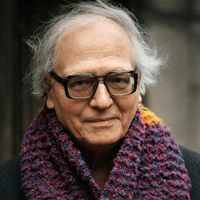
Olivier Messiaen
Olivier Messiaen (1908–1992) was a French composer, organist and ornithologist whose colour-rich, rhythmically intricate music stands among the major achievements of the twentieth century.

Tracks
- Apparition de l'église éternelle Olivier Messiaen 9:56
- Le Banquet céleste Olivier Messiaen 9:55
- Dieu parmi nous (from La Nativité du Seigneur) Olivier Messiaen 11:04
- Verset pour la fête de la Dédicace Olivier Messiaen 13:51
- i. Majesté du Christ demandant sa gloire à son Père 7:29
- ii. Alleluias sereins d'une âme qui désire le ciel 6:52
- iii. Transports de joie d'une âme devant la gloire du Christ qui est la sienne 4:59
- iv. Prière du Christ montant vers son Père 8:52
- Sortie Le vent de l'esprit (from Messe de la Pentecôte) Olivier Messiaen 4:08
L'Ascension Olivier Messiaen
Performers
- David Rumsey · organ
Where to listen
Meditation is available for streaming through Apple Music. It can also be purchased through the iTunes Music Store.
Meditation is available as a CD. It can be purchased online through Buywell Music or the Australian Music Centre which both offer online ordering.
Product details
- Catalogue number
- TP097
- Total playing time
- 77 minutes 6 seconds
- Recording Engineer
- Belinda Webster
- Venue
- Sydney Town Hall
- Release date
- 26 Sep 1997
- Label
- Tall Poppies
- Musical work
copyright - © 1997 Tall Poppies Records
- Sound recording
copyright - ℗ 1997 Tall Poppies Records
- Categories
- Great Classics, Modern Masterpieces
- Genres
- Organ, Modernist Classical
- Barcode
- EAN 9399001109722