Raymond Hanson: Violin Music
Raymond Hanson (1913–1976) is one of Australia’s most neglected composers. His music is rarely heard in concert, and even more rarely on disc. Access to the scores is part of the problem: most of the works recorded here survive only in manuscript in the Sydney Conservatorium library.
Susan Collins has written an illuminating doctoral thesis on Hanson’s violin music, and as part of that work she has painstakingly edited violin parts for performance. The only previous recordings were made by the ABC, and the original 78s have been destroyed. This CD will go a small way towards rectifying that situation, and hopefully will encourage others to take up the mantle.
As a teacher Hanson influenced many Australian composers and musicians. He was interested in jazz and Aboriginal music, and had a good knowledge of current compositional trends world-wide. His teaching stressed accessibility – he was not interested in the lonely ivory tower of “difficult” music, but in finding and expressing universal truths. Most listeners will find the music appealing and thought-provoking. As Hanson said: “If you want to be incomprehensible, go and get it. I don’t.” and “… what Beethoven had is the common touch… this wonderful contact between the creator and the listener… This is what I have endeavored to do through my life.”
Susan Collins and David Miller give superb performances. At the time of release Susan taught violin at the University of Newcastle and David taught accompaniment at the Sydney Conservatorium.
Reviews
Hanson was pretty much self-taught as a composer. Born in Sydney in 1913 he taught piano amongst other things before the Second World War, which interrupted his conservatoire studies. He became a teacher of Aural Training at the New South Wales conservatorium after the war ended and a valued teacher to a generation of composers and instrumentalists. He died of a heart attack in 1976.
This bald summary doesn't prepare one for the unexpected modernity of much of Hanson's writing. The Violin Sonata Op.5 is an early work written in 1939 and still therefore a product of his self-taught compositional relative youth. It really is a sonata for violin and piano because the latter, Hanson's own instrument, is just as feisty as the fiddle. There is for instance strong chordal writing, sometimes overpoweringly so. The idiom is at times vaguely Delian harmonically, though I wouldn't want to make too much of it – there are Baxian elements as well. Hanson clearly liked false endings, which here is a formal weakness. The structure is quite diffuse and one feels the piano writing is almost too big to fit into the democratic duo ensemble, especially the ceaseless roulades of the finale with its probably accidental Hindemith-like moments. It is an exacting, exciting work, sprawling and rather undisciplined but it has real personality and a 'stance'. The violin's accompanying figures and decorations in the finale are almost ancillary to the piano's garrulous strength; I'd even go so far as to say that at times it becomes that rather rare post-Mozartian and Beethovenian beast, a sonata for piano and violin.
The Three Fancies of 1946 lives up to its name. The first is busy and loquacious, rather as one imagines Hanson to have been, but the central Fancy is different. Here the fiddle's rarefied line is contrasted against the piano's increasingly changeable garrulity. Hanson wrote Seascape in 1953. Again the piano writing is sinewy, purposeful, and here Hindemith-inflected. The intervals are fascinating and it's a most impressive work – brief, urgent, and sweeping. Idyll hearkens back to Debussy and Delius. An Etching was the last of the works in this recital to be written, in 1969, and is short and strikingly atonal but also embraces the kind of Australasian bird calls that have so permeated the musical language of some composers from the country. The Legende is serious and reflective without becoming at all mordant, whilst the last piece – Portrait of Australia Op.46 – is a transcription by the composer of the theme from the film of the same name.
Susan Collins and David Miller respond to Hanson's very personal chromatic writing, with great perception. Both musicians bear tremendous technical and musical responsibilities in these works and they do so with acute assurance. The recording is first class. The yellowing newspaper style booklet drove me to distraction and there aren't enough biographical details for the newcomer, but don't be sidetracked by such ephemeral matters. This is the music of an Australian iconoclast. Sometimes you'll like it, sometimes you'll recoil, but it's never dull.
Australian Raymond Hanson (1913-76) looks set to become one of those composers whose music, freed from the stylistic constraints of time and place, enjoys a posthumous reputation way beyond anything it experienced in their lifetime. Such are the vagaries of taste and opinion that Hanson’s distinctive amalgam of Hindemith, Ravel and Delius fell on deaf ears during the 1930s and 40s as being too advanced. Yet by the 1960s, when the avant-garde was in full swing, his tonal language had effectively had its day. Fascinatingly, this recital shows Hanson responding (most notably with An Etching of 1969) with an atonal zeal that seems light years away from his masterly Violin Sonata, unbelievably written before Hanson had received any professional training in composition.
Hanson is very much his own man, but his closest equivalent is probably Arnold Bax, with whom he shares a predilection for mixtures of whole-tone and chromatic harmony, coupled with a virtuoso command of texture and post-Romantic rhetoric that effortlessly leads the ear on. Susan Collins, who made Hanson’s music the subject of her doctoral thesis and now teaches violin at Newcastle University Australia, plays these extraordinary scores with a remarkable sureness of touch, following even the most unexpected shifts in phrasing and expressive direction with micro-fine precision. Her warm, rich sound works wonders in bringing this music alive, enhanced by a generous, medium-paced vibrato and sensitivity to dynamic shading that comes as no surprise when one learns that her mentors have included the great Thomas Zehetmair.
Hanson’s hugely demanding piano writing could hardly wish for a more persuasive advocate than David Miller, and the recording projects a most believable impression of a medium-sized concert hall.
The music of Raymond Hanson is gradually assuming the significant position it richly deserves in Australian composition, and this CD forms a welcome part of that process. Virtually self-taught as a composer, he never studied abroad, yet managed to forge an individual voice characterised by a basically tonal language, though employing bitonality, chromatic inflections and atonal procedures as the years progressed. Always adhering to Hindemith's belief in diatonic principles, spiced with the underlying concept of harmonic tension and relaxation, he exerted a profound influence on generations of young composers at the (then) NSW State Conservatorium in Sydney. One wonders about the style Hanson would have cultivated had he lived longer: his death (1976) in his early sixties from prolonged cancer robbed Australia of one of its most distinguished creative figures.
There are seven works here, demonstrating an evolving style from the late thirties to the late sixties. The principal offering is the Sonata Opus 5, a substantial three-movement work dating from the same period as the Piano Sonata (completed in 1940, revised in 1963). Though not approaching the stature of its keyboard equivalent, the Violin Sonata emerges as a completely compelling utterance, with frequently soaring violin lines and rich piano textures. Hanson himself was an accomplished pianist, but the writing for both instruments comes across as thoroughly cognizant of the technical possibilities involved. This is accessible yet strangely perplexing music, confirming my opinion that this composer was literally eccentric: different from the mainstream, and in a totally refreshing way. The harmonic language draws on various sources – late and neo-Romanticism, Impressionism, even occasionally Sibelius – yet there is a dominant personal trait. The next-most-substantial work – the harmonically more adventurous Three Fancies – forms an unusual set: its brooding middle movement contrasts nicely with the humorous touches of its neighbours, especially in the final movement.
The rest of the disc contains five shorter pieces. Their titles all give some indication of their 'program' or essential atmosphere: Seascape (1953), Idyll Opus 2 (1938), An Etching (1969), Legende (1946) and Portrait of Australia Opus 46, the composer's own transcription of the theme from a film commissioned by Caltex Oil. The intriguing sound-world of Seascape and quirky, nervous gestures of An Etching are particularly memorable.
Overall, this CD seems rather mixed. My reservations are certainly not about the performances, which are technically and emotionally convincing, reflecting a strong sense of a real partnership between the players; nor are they about the recording quality, which possesses an appealing ambience and spotlights the warm resonance of the Overs piano. For my taste, the packaging is drab, with photocopies of old newspaper articles in miniscule type depicted (booklet and disc) on a blotchy yellow background; there are discrepancies in the size and style of fonts (obviously intended but somewhat confusing); the information supplied about opus numbers and compositional dates is incomplete; the timing listed for the Sonata is inaccurate; and Susan Collins's thoughtful annotations are carelessly proof-read. A pity, since the performances and sound quality are so admirable.
Raymond Hanson, who died in 1976, taught and influenced a whole generation of Australian composers but his own works have been neglected. Part of the reason is that his scores only exist in manuscript form in the Sydney Conservatorium, but violinist Susan Collins has edited some parts for performance and the result of a lovely recording on the Tall Poppies label.
It opens with Sonata Op 5, written on the eve of World War II, and a very fine piece is it, showing that Hanson knew his Fauré and Franck and yet had his own distinctive voice. Much of his music shows the influences of jazz and Aboriginal music, as well as the European tradition. Collins and pianist David Miller perform seven of Hanson’s works on this CD.
The sonata is perhaps the pick of the bunch but there’s a great depth and variety to Hanson’s work. Legende is a darker piece while his lighter more playful side comes out in Three Fancies.
This is far more than salon music and it is a real discovery, Collins and Tall Poppies are to be congratulated for helping to restore this gifted composer to a wider public.
Artists

David Miller
David Miller partners flute and violin across Australian chamber music that ranges from Carl Vine's driving, open-air sonatas to Anne Boyd's modal Asian-inflected reveries, Raymond Hanson's post-Romantic rhetoric and John Lemmoné's flashy salon caprices.
Raymond Hanson
Raymond Hanson's scores favour evolving melodic lines and purposeful piano textures. The violin works and piano preludes show a tonal language spiced with chromatic bite, jazz rhythm and a clear resistance to serial fashion.
Tracks
- i.
- ii. 6:37
- iii. 6:09
- i. 4:30
- ii. 3:57
- iii. 3:16
- Seascape (1953) Raymond Hanson 7:46
- Idyll, Op. 2 (1938) Raymond Hanson 7:56
- An Etching (1969) Raymond Hanson 2:16
- Legende (1946) Raymond Hanson 9:17
- Portrait of Australia, Op. 46 [transc.] Raymond Hanson 5:06
Sonata, Op. 5 Raymond Hanson
Three Fancies (1946) Raymond Hanson
Performers
- David Miller · piano
- Susan Collins · violin
Where to listen
Raymond Hanson: Violin Music is available for streaming through Apple Music. It can also be purchased through the iTunes Music Store.
Raymond Hanson: Violin Music is available as a CD. It can be purchased online through Buywell Music or the Australian Music Centre which both offer online ordering.
Product details
- Catalogue number
- TP197
- Total playing time
- 56 minutes 50 seconds
- Release date
- 28 Jul 2008
- Label
- Tall Poppies
- Musical work
copyright - © 2008 Tall Poppies Records
- Sound recording
copyright - ℗ 2008 Tall Poppies Records
- Category
- Australian Classics
- Genres
- Contemporary Classical, Romantic & Impressionist
- Barcode
- EAN 9399001001972
Related recordings
There Came a Wind like a Bugle: Chamber Music by Nigel Butterley
Chamber works spanning some thirty years by Nigel Butterley, one of Australia’s finest composers, for soloists, song and choir.
Carl Vine: Chamber Music, Vol. 2
World premiere recordings of Carl Vine's Second Piano Sonata, played by Michael Kieran Harvey, and Third String Quartet, by the Tall Poppies Quartet (John Harding, Georges Lentz, Esther van Stralen and David Pereira).
Crossing a Bridge of Dreams
This CD gathers some of Anne Boyd's most enduring works, mostly from the 1980s. Many pieces reflect her passion for Asian music, heard especially in the flute writing. Premiere performers return for the recording, among them John Harding on viola in My Name Is Tian.
John Lemmoné: The Flute Music
Lemmoné was Dame Nellie Melba’s accompanist and musical director. He wrote very much in the style of the day, with an eye to his audience and a willingness to provide flashy displays of technique—good taste, it appears, was never a burning issue.
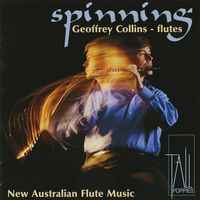
Spinning: New Australian Flute Music
Geoffrey Collins has single-handedly shaped the Australian flute repertoire, and this is his third solo recording. Five of these works were written for him, and they show how freely composers respond to his playing.