Mozart & Brahms: The Clarinet Quintets
Catherine McCorkill joins the Australia Ensemble for two pillars of the clarinet chamber repertoire: Mozart’s Clarinet Quintet in A major, K. 581, on basset clarinet, and Brahms’s Clarinet Quintet, Op. 115.
Dene Olding violin
Julian Smiles cello
Australia Ensemble ensemble
Irina Morozova viola
Catherine McCorkill basset clarinet, clarinet
The Australia Ensemble partners McCorkill in Mozart’s Clarinet Quintet in A major, K. 581, heard on basset clarinet, and Brahms’s Clarinet Quintet, Op. 115.
The performances were recorded at the Sir John Clancy Auditorium.
Reviews
This is another endearing and memorable recording from the Tall Poppies collection. Five well-known members of the Australia Ensemble - Dene Olding (violin), Dimity Hall (violin), Irina Morozova (viola), Julian Smiles (cello) and Catherine McCorkill (basset clarinet and clarinet in A) - come together for performances of the Mozart Clarinet Quintet K581 in A major, and the Brahms Clarinet Quintet Op.115 in B minor. To add to the interest McCorkill plays a modern "conjectural reconstruction" of the basset instrument which Mozart’s friend and Viennese clarinet virtuoso, Anton Stadler, played in the original version of K581. The basset clarinet is notable because it extends the lowest register of the clarinet downwards by four semitones. The ordinary clarinet in A is used in the Brahms Quintet. These two Quintets are so well-known that the music hardly needs introduction. The Mozart is in general terms a lighter work than the Brahms, but it is a work of simple and straightforward beauty.
Mozart exploits in typically elegant fashion the contrast in tone colour between the clarinet and the strings. Often the clarinet merges with the strings to produce a rich texture of sound, but more frequently the clarinet is distinguished as a solo voice - at times clear and commanding in its upper registers, and at others times soft and warm as it descends into the depths. It is required to perform sweeping arpeggios, illustrating the flexibility of the instrument, and making great technical demands upon the player. The thematic material is always interesting.
The approach by the Ensemble is light-hearted and joyous, with occasional moments of deep sadness. The slow movement (Larghetto), in which the strings are muted, is particularly entrancing in this recording: the clarinet sound weaves in and out of the background provided by the strings in a seemingly effortless and almost sensuous manner.
The Brahms Quintet is different. It is in a minor key, and it has a brooding and sombre quality which contrasts with the generally joyous nature of the Mozart: the phrasing is more complex, the texture is thicker and the structure is much looser. Written a century after the Mozart work, it is the product of Romanticism and, as one would expect, it shows much greater freedom of expression in its composition. Like Mozart, Brahms makes impressive use of arching arpeggios which exploit the range and agility of the clarinet. Again, the slow movement is eloquent. The strings are muted in this Adagio of elegiac sadness.
Listening to the Mozart Quintet one feels at times that it could be a small concerto for clarinet and strings, whereas one of the most striking features of the Brahms is the manner in which the five parts are integrated: the writing for the clarinet is often brilliant, but never dominant.
Problems of securing a proper balance between differing tone colours confront any composer writing for a wind instrument with strings. They also confront the players head on during live performance, and the exposition of the Australia Ensemble in this regard is excellent for both works. Instrumental ensemble, balance and the blending of timbres are beyond criticism, in fact, inspirational.
Definitely a CD to acquire!
Artists
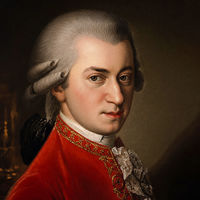
Wolfgang Amadeus Mozart
Wolfgang Amadeus Mozart was a prolific and influential composer of the Classical era. He wrote over 600 works, many of them pinnacles of symphonic, concertante, chamber, piano, operatic and choral music, and remains among the most enduringly popular of classical composers.
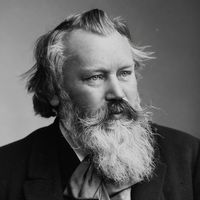
Johannes Brahms
Johannes Brahms (1833–1897) was a German composer and pianist of the Romantic period. His music for piano, chamber ensemble, orchestra, and voice remains central to the concert repertoire.
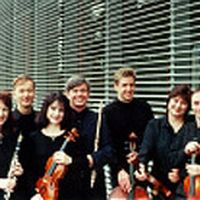
Australia Ensemble
The Australia Ensemble, resident at the University of New South Wales since its founding in 1980, is widely recognised as Australia’s leading chamber music ensemble. Seven principal instrumentalists form its core, joined by guests for standard repertoire and unusual combinations.
Tracks
- Allegro 9:14
- Larghetto 6:54
- Menuetto 6:54
- Allegro con variationi 9:21
- Allegro
- Adagio
- Andantino – Con moto
Clarinet Quintet in A major, K. 581 Wolfgang Amadeus Mozart
Clarinet Quintet, Op. 115 Johannes Brahms
Performers
- Dimity Hall · violin
- Dene Olding · violin
- Julian Smiles · cello
- Australia Ensemble · ensemble
- Irina Morozova · viola
- Catherine McCorkill · basset clarinet, clarinet
Contributors

Liner Notes
Catherine McCorkill
Catherine McCorkill's clarinet playing is delectable and flexible: basset clarinet for Mozart's Quintet, warm A clarinet for Brahms, and a clean, precise voice inside Australian chamber scores of outback pulse, stillness and political colour.
Where to listen
Mozart & Brahms: The Clarinet Quintets is available for streaming through Apple Music. It can also be purchased through the iTunes Music Store.
Mozart & Brahms: The Clarinet Quintets is available as a CD. It can be purchased online through Buywell Music or the Australian Music Centre which both offer online ordering.
Product details
- Catalogue number
- TP131
- Total playing time
- 32 minutes 23 seconds
- Producer
- Belinda Webster
- Recording Engineer
- Belinda Webster
- Venue
- Sir John Clancy Auditorium
- Credit
- Catherine McCorkill
- Release date
- 7 Jan 2001
- Label
- Tall Poppies
- Musical work
copyright - © 2001 Tall Poppies Records
- Sound recording
copyright - ℗ 2001 Tall Poppies Records
- Category
- Great Classics
- Genres
- Classical Era, Romantic & Impressionist
- Barcode
- EAN 9399001113125
Related recordings
Le Tango Perpetuel
Ian Munro, superb pianist and imaginative composer, turns piano masterworks into chamber colour for the Australia Ensemble. The disc also preserves a rare late performance by tenor Gerald English in Satie’s Sports et Divertissements.
Mozart: Sonatas K. 570, 282, 333
Geoffrey Lancaster returns with three Mozart keyboard sonatas on fortepiano. His earlier Tall Poppies set of the K. 330–332 group had already won strong critical notice.
Mozart: Keyboard Sonatas, K. 330-332
By 2017 Geoffrey Lancaster was deep into the fifth decade of his performing career. Tall Poppies first recorded him in Mozart in 1991, accompanying the Song Company on Mozart Unexpurgated. A quarter-century later he returns to the composer with three of the best-loved keyboard sonatas.
In Other Words
Violinist Anna McMichael and pianist Daniel de Borah devised this programme of transcriptions, two of Australia’s most accomplished chamber musicians. They play the music with virtuosity and style.
Ensemble Liaison: Bruch, Brahms, Beethoven
This is Ensemble Liaison’s debut CD. Formed in 2006, the group was Monash University’s Ensemble in Residence, had performed throughout Australia including for Musica Viva, and had appeared on ABC-TV’s Sunday Arts programme.
Romantic Rarities
Ian Holtham is a distinguished Melbourne pianist with a long discography of Classical and Romantic repertoire, especially Chopin. On his first Tall Poppies release he turns to relatively rare works from the piano literature.