Peggy Glanville-Hicks: The Songs
World premiere recordings of songs by Australian composer Peggy Glanville-Hicks, including the cycle Thirteen Ways of Looking at a Blackbird, sung by tenor Gerald English.
Roland Peelman piano
Marshall McGuire harp
Antony Walker conductor
Tasmanian Symphony Orchestra orchestra
George William Russell lyrics by
Alfred Edward Housman lyrics by
Eunice Tietjens lyrics by
Wallace Stevens lyrics by
John Fletcher lyrics by
The programme ranges from the aphoristic Profiles from China and Housman settings through Wallace Stevens's Thirteen Ways of Looking at a Blackbird to the orchestral song cycle Letters from Morocco.
Her concise Sonata for Harp is also included. The recordings were made in Canberra, Sydney and Hobart in 1993 and 1994.
Reviews
Recordings by Gerald English are as precious as sunshine in winter. I treasure broadcast tapes of BBC Radio 3 broadcasts by him including a superb account of Finzi's Oh Fair to See and the songs of Jasper Rooper. He is also well recalled for his role in Walton's Troilus and Cressida. He is not part of the great homogeneous sea of tenors churned out on a production line. His voice has poignancy - a penetrating nasal quality, probing and ecstatic. Glanville-Hicks is well served by it.
Glanville-Hicks was born in Melbourne and studied with Vaughan Williams, Boulanger and Wellesz. She had sojourns in Greece and the USA. She learnt her operatic craft (there are four operas and five ballets) working with Fritz Hart before his departure to Hawaii. She was married for some years to the Plymouth-born composer, Stanley Bate, whose turbulence-riven Third Symphony (1945), premiered by Adrian Boult, is a prime candidate for revival on CD.
The Chinese Profiles are settings of aphoristic poems by Eunice Tietjens. The style will be instantly familiar to and loved by anyone who has taken to the 1920s Li Tai Po settings of Arthur Bliss and Constant Lambert. The moon, rain, drunken poesy, melancholy and mossy gardens are the subject matter. The composer matches the subjects with concision and emotion.
Of the three miscellaneous songs two are by the Irish poet AE and the third is Fletcher's oft-set Sleep. These are recognisably of the genre of British lyrics. They are variously racked by the rolling Celtic surge while Sleep, in its regretful self-hypnosis, stands comfortably in the company of Gurney's and Warlock's settings of the same words. With the five Housman settings we move further into mainstream English song territory and these are as gloriously melancholy and deliciously pessimistic as the Orr, Gurney, Ireland and Vaughan Williams settings. Note the rippling arpeggio in Stars.
The Harp Sonata is a succinctly expressed delight. Serenade-like in character it strikes me as a three movement troubadour song shot through with voices familiar from William Alwyn's Lyra Angelica at one extreme and Haydn's British folksong settings at the other. I was not surprised to read that this was the most broadcast piece of Australian music in 1996.
The Wallace Stevens songs gallop lightly, glitter starrily, speak soft profundity, slewing between Britten-like economy and Finzian tenderness. These must be heard by anyone who reckons himself or herself a lover of British song.
The Letter from Morocco is the only sequence here to be accompanied by orchestra. It was borne out of composer, Paul Bowles' letters to Glanville-Hicks. These letters were part of a forty year correspondence. The sequence is honeyed, exotic, romantic, desolate and deeply serious. There is a touch of Warlock's Curlew about this. The orchestration is a glimmering web - as rich as that conjured by Szymanowski and yet not suffocating the vocal line.
A delightful disc. Good notes and technical aspects. Matchless singing. This is a discovery I am very pleased to share and recommend.
The amazing Paul Bowles (1910-99)--composer, novelist, translator, existentialist, expatriate, and general literary cult figure--seems to have been able to transfer his Midas touch to others just by knowing them. The notes to this recording make much of Australian composer Peggy Glanville-Hicks's (1912-90) long friendship with Bowles, extracts of whose letters Glanville-Hicks set to music as the orchestral song cycle Letters from Morocco (1952). Glanville-Hicks has taken on a bit of cult status herself. Born in Melbourne, she studied with Vaughan Williams, Wellesz (ironic, given her antipathy to serial music), and Boulanger. Later, in America, she served for 10 years as a music critic for the New York Herald Tribune (under the editorship of Virgil Thomson) and organized the concert series of the Museum of Modern Art.
Ever the expatriate, Glanville-Hicks's love of the world is reflected in her choice of texts. Profiles from China is a setting of five poems by the widely traveled American poet Eunice Hammond Tietjens. Mimic Heaven sets five poems by Houseman, while Thirteen Ways of Looking at a Blackbird tackles Pulitzer Prize winner and insurance executive Wallace Stevens's famous poem of the same name.
These works vary widely. The Blackbird songs don't work all that well, but that may be because Stevens's cycle defies musical treatment. On the other hand, the settings of the more conventional Houseman lyrics are quite good, while Letters from Morocco, introduced by Stokowski, is a real find.
Gerald English, who has been singing more than 40 years, does well with this demanding material, his age notwithstanding. Granted, the recordings were made in 1993-94, but English sounds as if he were a much younger man. Unfortunately there are times when the wear and tear of a four-decade career shows through uncomfortably. This is especially true in the more delicate parts of the Blackbird songs and in the demanding passages that imitate the call of the muezzin in 'Wind, Water, Birds, and Animals', which opens Letters from Morocco.
Sound in the songs with piano is very realistic, slightly favoring the piano. In the orchestral songs, though, the orchestra sounds as if it were playing behind a curtain, with English well up front, a fault I've noticed in other concert tapes from the Australian Broadcasting Company.
Thrown in for good measure is the delightful Harp Sonata, which neatly fills out this program of unusual music by a most unusual woman.
Artists
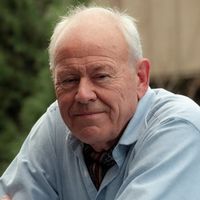
Gerald English
Gerald English (1925–2019) enjoyed a long career as a tenor in operatic and concert repertoire, as a recording artist and as an academic. He gave premiere performances of major twentieth-century works, often under the composers’ own direction, and forged close ties with Stravinsky, Henze, Britten, Tippett and Ford.

Peggy Glanville-Hicks
Peggy Glanville-Hicks (1912–1990) was an Australian composer, born in Melbourne, whose career carried her through London, New York and Greece. She wrote operas, chamber music, song cycles and a concise Sonata for Harp that remains widely played.

Roland Peelman
Belgian-born conductor, pianist and artistic director Roland Peelman has shaped Australian music for more than three decades. A mentor to composers and singers, he is known especially for his long leadership of The Song Company and for championing new work.

Marshall McGuire
Marshall McGuire brings the harp into contemporary Australian music with uncommon colour and nerve. He specialises in both baroque and modern repertoire, drawing out unusual sonorities and serving new works with technical sureness and interpretative sympathy.

Antony Walker
Born in Sydney, Antony Walker is an Australian conductor whose reputation for artistic excellence in direction and performance places him among the leading musicians of his generation.

Tasmanian Symphony Orchestra
The Tasmanian Symphony Orchestra has an enviable reputation as one of the world's great small orchestras. With a full-time strength of 47 players, which can be augmented when the programme demands, it is known for classical polish and a lively commitment to new work.
Tracks
- Poetics :57
- A Lament of Scarlet Cloud 1:27
- The Dream 1:39
- Crepuscule :49
- The Son of Heaven 1:42
- Frolic 1:19
- Rest 3:11
- Come Sleep 2:12
- Mimic Heaven :45
- He Would Not Stay 1:45
- Stars :56
- Unlucky Love 1:58
- Homespun Collars 1:28
- i. 4:06
- ii. 2:24
- iii. 3:53
- 1. Among Twenty Snowy Mountains :29
- 2. I Was of Three Minds :53
- 3. The Blackbird Whirled in the Autumn Winds :30
- 4. A Man and a Woman Are One 1:28
- 5. I Do Not Know Which to Prefer :41
- 6. Icicles Filled the Long Window 1:07
- 7. O Thin Men of Haddam :30
- 8. I Know Noble Accents and Lucid 1:03
- 9. When the Blackbird Flew Out of Sight :30
- 10. At the Sight of Blackbirds Flying :50
- 11. He Rode Over Connecticut :35
- 12. The River Is Moving 1:45
- 13. It Was Evening All Afternoon 1:44
- Letters from Morocco Peggy Glanville-Hicks 15:25
Profiles from China Peggy Glanville-Hicks Eunice Tietjens
Three Songs Peggy Glanville-Hicks George William Russell
Mimic Heaven: Five Songs by A.E. Housman Peggy Glanville-Hicks Alfred Edward Housman
Sonata for Harp Peggy Glanville-Hicks
Thirteen Ways of Looking at a Blackbird Peggy Glanville-Hicks Wallace Stevens
Performers
- Gerald English · tenor vocals · all except tracks 14–16
- Roland Peelman · piano · tracks 1–13
- Marshall McGuire · harp · tracks 14–29
- Antony Walker · conductor · track 30
- Tasmanian Symphony Orchestra · orchestra · track 30
Composers
John Fletcher
John Fletcher is the lyricist of Come Sleep, a text long favoured in the English art-song tradition.
Alfred Edward Housman
Alfred Edward Housman's A Shropshire Lad gave English song its most durable pastoral texts: spare, fatalistic lyrics of youth, death and an idealised countryside that composers keep returning to for cycles of art song.
Contributors
Liner Notes
James Murdoch
Liner Notes
Marshall McGuire
Marshall McGuire brings the harp into contemporary Australian music with uncommon colour and nerve. He specialises in both baroque and modern repertoire, drawing out unusual sonorities and serving new works with technical sureness and interpretative sympathy.
Where to listen
Peggy Glanville-Hicks: The Songs is available for streaming through Apple Music. It can also be purchased through the iTunes Music Store.
Peggy Glanville-Hicks: The Songs is available as a CD. It can be purchased online through Buywell Music or the Australian Music Centre which both offer online ordering.
Product details
- Catalogue number
- TP112
- Total playing time
- 58 minutes 1 seconds
- Producer
- Belinda Webster
- Recording Engineer
- Belinda Webster
- Credit
- James Murdoch
Marshall McGuire - Release date
- 26 May 1999
- Label
- Tall Poppies
- Musical work
copyright - © 1999 Tall Poppies Records
- Sound recording
copyright - ℗ 1999 Tall Poppies Records
- Categories
- Australian Classics, Modern Masterpieces
- Genres
- Vocal & Opera, Contemporary Classical
- Barcode
- EAN 9399001111220
Related recordings
Le Tango Perpetuel
Ian Munro, superb pianist and imaginative composer, turns piano masterworks into chamber colour for the Australia Ensemble. The disc also preserves a rare late performance by tenor Gerald English in Satie’s Sports et Divertissements.
From the Hungry Waiting Country
Three astounding works by Elliott Gyger are presented by Halcyon, featuring the thrilling voices of Jenny Duck-Chong and Alison Morgan with some of Australia’s best performers. Challenging music that rewards every listen, full of mystery and glistening textures, its narrative holds you to the end.
Bright Vessel
Tall Poppies is proud to release Bright Vessel, an important collection of Australian works for solo oboe and oboe d’amore, gathered and performed by Stephen Robinson.
Bruce Cale: Orchestral Works
Tall Poppies is delighted to present Australian orchestral works that might well have slipped from view forever but for the archives of their composer, Bruce Cale.

Red Earth
A world-premiere recording of important Australian works for instrumental ensemble. Performers and repertoire were hand-selected for the project, which was funded by the Australia Council.
Mirrors of Fire
Every now and then a CD comes along that makes you glad to be alive: the music is so infectious and the performances brilliant. This is one such disc, featuring Timothy Kain, Australia’s virtuoso guitarist.