Peter Sculthorpe: The String Quartets, Vol. 3
Tall Poppies presents this third volume of Peter Sculthorpe’s string quartets as a tribute on the occasion of his 80th birthday in April 2009.
Dimity Hall violin
Dene Olding violin
Julian Smiles cello
Irina Morozova viola
World premiere recordings in the presence of the composer.
This recording was made at Sydney’s City Recital Hall, Angel Place, in December 2008. The four quartets, written between 1998 and 2007, range across Sculthorpe’s compositional interests: close four-part harmony, dramatic contemporary rhythms, and melodies of love and anguish.
The performances are exceptional. Peter Sculthorpe, present throughout the sessions, was thrilled with the results.
The recording was funded by the Browne family in memory of the music critic Lindsey Browne (1915–2003).
Reviews
The third in a series of Goldner String Quartet recordings of pieces by Peter Sculthorpe, this CD covers works written from 1998 up to the present. Considering why Sculthorpe occupies a place as Australia’s best-known living composer, Roger Covell has pointed to Sculthorpe’s "persistence with the principle of a single big idea: a deliberate, repeatedly emphasised identification of his music with Australian landscape in contrast with the imported European tradition". This is generally evident in the use of simple structures, the emphasis of particular melodic intervals, and a feeling of harmonic stasis. Sculthorpe’s music is largely gestural, although he often writes melancholy melodies, recalling a pastoral upbringing in Tasmania. These elements run through the four quartets of this collection.
The four quartets represented on this disc draw inspiration from a broad range of sources: the 14th, from the legend of an Aboriginal massacre occurring at Quamby Bluff, was later adapted as a piece for chamber orchestra; the 15th, on a sequence of songs by the people of the Simori mountains in Western New Guinea; the 16th, from the letters of refugees held in detention in Australia, and referencing Afghani music; and the 17th based on the theme of the fourth movement of Beethoven’s last string quartet (also the 17th). Given such diverse influences, it is amazing how Sculthorpe can internalise those influences and still create pieces very much of his own voice. Melodies, when they appear usually rise up out of a gestural web to sneak into our perception – but they do not have an easy birth. A case in point is the third movement of the 16th, named Yearning. Although the melody is introduced by the lower instruments, yet incomplete, it is not until half-way through the movement that the violins take up the melody in a more obvious form. The result is quite surprising.
Sculthorpe’s melodic structures are often short and can be unsatisfying, easily subsumed within the background of gestures. When grouped together on a CD such as this, the commonalities between the pieces become evident, such as an over-use of the sliding glissandi harmonic ‘seagull sound’.
The 15th quartet draws elements from, without directly emulating, music of West Papua – the titles of the movements hint at tribal life – but also drawing on the rhythms of Australian Aboriginal music from the top end, and Balinese gamelan.
The 16th quartet seeks to tap raw emotions found in the letters of asylum seekers held in Australian detention centres. Sculthorpe drew from a love song from central Afghanistan as a core influence. It is here that we hear Sculthorpe at his most angry and dissonant, but also in the deepest lamentation.
Performances on the disc are sound. There is certainly contrast in the range of performance techniques, from aggressive and raw to pure and sweet. By ear, there are perhaps some liberties being taken especially by the first violin in the 17th quartet, but that would have to be confirmed by sighting the score.
This is an interesting collection of pieces for string quartet demonstrating a unity of style yet crossing a broad range of influences – very enjoyable!
A unique and distinctive expression of loneliness, yearning and ferocious anger
This third instalment in the Goldner’s Sculthorpe series brings us to 2007, including the 14th (1998), the 15th (1999), the 16th (2005) and the 17th (2007), and it is surely a partnership made in heaven. The Goldners have a flawless technique, of course, but also a profound understanding of Sculthorpe’s musical aims and vocabulary; there’s always a sense of every element of each quartet being linked inextricably to the whole, even when quite disparate in character – for example, the almost terrifying quality of the second movement of No. 14 ("In the Valley") immediately followed by the kind of sentimentality that appears in quotation marks (or does it?) of the third, "On High Hills". While such contrasts may be part and parcel of any composer’s vocabulary, there’s an organic quality about the music which is fully matched by that of the performances.
The two most recent quartets, Nos 16 and 17, are particularly fascinating because they are so recent, of course. The first of these takes off from an Afghan love song, and deals with loneliness – a very Sculthorpian theme, but this time within the specific context of asylum-seekers in Australia. Some of the music is unexpectedly, ferociously angry, some of it heart-rendingly yearning (indeed, "Yearning" is the title of the third movement). No. 17 is, on the surface, rather stranger, based as it is on the "Muss es sein?" motto from Beethoven’s Op. 135 Quartet, but while there is, perhaps, a more classically European quality about a good deal of the melodic writing, its simultaneous sense of intimacy and great breadth is uniquely Sculthorpe.
The third volume of the Goldner Quartet’s traversal of pre-eminent Australian composer Peter Sculthorpe’s complete music for string quartet brings things right up to date, with four works from the last eleven years (two more quartets are in the pipeline, the booklet note promises). The music here is more direct and straightforward than the sometimes more abstract works of the earlier discs, and often has a story to tell.
The Quartet no. 14 ‘Quamby’, for instance, is based around memories of Sculthorpe’s childhood in Tasmania, but also deals with the story of a massacre of native Tasmanians by settlers at Quamby Bluff. Quartet no. 16 was inspired by the hopes, fears and anger of asylum seekers in Australia’s detention camps, in music ranging from a heart-rending Afghan love song (delivered eloquently by violinist Dene Olding) to some fiercely dissonant shrieks of despair. The Goldner players convey the drama of these works magnificently in playing that is committed, passionate and superbly controlled. Julian Smiles is particularly impressive in some of Quartet no. 14’s rich, resonant cello lines.
However, it’s in Quartet no. 17, a glowing homage to friendship based around the ‘Es muss sein?’ motto from Beethoven’s last quartet, that the ensemble really shines, demonstrating some radiant, expressive playing in music of great subtlety and depth. Recorded sound is clear and warm, although there’s a slight ambient hiss in the background throughout.
The Goldner String Quartet magnificently evokes Peter Sculthorpe’s sound world from the very first to last bars on this CD. Indeed, this is playing of the highest order and Graeme Skinner’s excellent annotations are a real bonus.
The disc celebrates the composer’s 80th birthday in 2009 and includes his latest string quartets, Nos 14–17. Hats off to all concerned. Peter Sculthorpe, the Goldners, the Browne family who funded the CD in memory of Lindsey Browne, an arts/music reviewer par excellence and Tall Poppies for having the vision to record all the Sculthorpe string quartets. These are fine works beautifully played. Go out and buy!
Goldner String Quartet’s project to record all the quartets by Peter Sculthorpe is brought up to date in this third instalment, covering 1998 to the present. There are four works, String Quartets No. 14–17, and all are recorded here for the first time. One hears a composer who has found his most natural voice in the string quartet medium. These later quartets have a distilled character: textures are cleanly formed and melodies are tunefully simple, at times impassioned. Big sociopolitical themes sparked these works. Quartet No. 14 (Quamby) is Sculthorpe’s response to folkloric stories from the 19th century about the massacre of Aborigines in northern Tasmania. It broils with intensified emotion. The more prayerful Quartet No. 15 laments the dispersal of the Simori people from their homeland in New Guinea. Haunting and anguished, Quartet No. 16 was triggered by the plight of asylum-seekers in Australian detention centres. Composed in 2007, the more abstract Quartet No. 17 is the most satisfying of the four. Quoting a theme of Beethoven, it has an expansiveness and musical complexity that seems to open the door on the composer’s inner self. Flowing, unforced musicianship from the Goldner players allows them to unlock fully the spirit of this music. Their playing is eloquent, human-faced and expressive.
Peter Sculthorpe celebrated his 80th birthday in April, and this recording of his four most recent numbered string quartets was released to mark the occasion. He has been the leading Australian composer of his generation; his works manage to evoke his country’s extraordinary landscapes while never shrinking from its social issues. So the 14th Quartet is subtitled Quamby, and evokes not only the Tasmania in which Sculthorpe grew up, but also its brutal colonial past: it identifies a place where Aborigines were massacred. The 15th looks across the Torres Strait to New Guinea, incorporating song sequences and scales from a local tribe; the 16th is designed as an appeal for justice for Australia’s asylum seekers; the 17th is more personal, and incorporates the motto from the last of Beethoven’s 17 quartets, Op 135. Yet the soundworld of all these works is identifiably Sculthorpe’s own, with its highly wrought, often densely chordal string writing lit up by sudden scatters of harmonics, like cascades of birdsong, and all superbly delivered by the Goldner Quartet.
Amidst all the hoopla for Handel and Haydn in this anniversary year, it’s easy to forget that Australia’s own Peter Sculthorpe has turned 80. This latest instalment in the survey of his quartets comprises the last four works of this genre. Written in the space of just over a decade, the breadth of Sculthorpe’s creativity is matched by the depth of his passion for the landscapes, musical styles, friendships and social issues that influenced him. Whether it be the terrain of his native Tasmania (now devoid of indigenous inhabitants), the dispersed Simori of Western New Guinea or the detained asylum seekers in our own country, Sculthorpe uses his genius to evoke and celebrate the human spirit in the midst of a contrary world. The Goldner Quartet, seasoned exponents of Sculthorpe’s work, gives thoroughly engaging accounts of Quartets 14–17. Recorded in the presence of the composer this is superb Australian art that no music lover should be without.
Somewhat belatedly, one of the Goldner String Quartet’s Sculthorpe series, celebrating Peter Sculthorpe’s 80th birthday last month, has been received for review. It comprises the prolific composer’s last four quartets (1998–2007) of the seventeen to date (two more are commissioned).
All of them have a strong basis in his pursuit of ‘an identifiably Australian idiom’; in 1967 he said "I never want to hear another note of Beethoven in my life!". However, No. 17 is based, quite transparently and openly, on the famous "Must it be? It must be!" motif from Op. 135, and makes a good culmination to this album. The others have more exoticisms, reflecting Tasmania’s landscape and history, e.g. songs from Western New Guinea in No. 15 etc (No. 8 – of which a movement was given in the Goldners’ 2007 Wigmore Hall recital reviewed above is Balinese-inspired).
This is a terrific sequence which we played right through with consistent interest and pleasure. I remember enjoying Sculthorpe’s music several decades ago, but he is not often heard in UK now. I would think that the full cycle of his quartets to be given by the Goldners would be welcome in London, rather akin to my like recommendation of Murray Schafer’s seven.
The first seventeen of Sculthorpe’s quartets are available in well presented Tall Poppies releases, each with expansive analytic essays and evocative cover images of paintings by his "friend and mentor" Russell Drysdale.
Artists

Goldner String Quartet
The Goldner String Quartet plays Peter Sculthorpe's complete string quartets with the authority of an ensemble totally inside the music: precise, tonally varied, and alive to landscape, ritual rhythm and sudden cascades of harmonics.
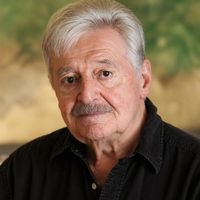
Peter Sculthorpe
Peter Sculthorpe (1929–2014) was a Tasmanian-born composer whose orchestral and chamber music drew the Australian landscape, neighbouring Asian traditions and Indigenous materials into a clear, personal language. He wrote extensively for strings, piano and voice.
Tracks
- i. Prelude (Inquieto) 2:48
- ii. In the Valley (Solenne) 4:16
- iii. On High Hills (Con tenerezza – Calmo – Con tenerezza) 4:26
- iv. At Quamby Bluff (Inquieto – Come preghiera – Calmato) 6:37
- i. A Song for Dancing (Ritmico) 4:14
- ii. An Exorcism (Drammatico) 2:12
- iii. A Song for Mourning (Con tristezza) 3:39
- iv. A Love Song (Calmo) 3:12
- v. A Song for Feasting (Ritmico) 2:18
- i. Loneliness (Con tristezza) 3:08
- ii. Anger (Deciso – Feroce) 4:13
- iii. Yearning (Espressivo) 5:40
- iv. Trauma (Intenso – Piangendo – Intenso – Loquace) 4:27
- v. Freedom (Con tristezza – Estatico) 4:45
- i. Prelude & Cadenza (Semplice – Risoluto) 3:32
- ii. A Song of Assurance (Amoroso) 4:22
- iii. A Song of Deliverance (Risoluto) 3:46
- iv. A Love Song (Sospirando – Molto cantando) 4:07
- v. Postlude (Risoluto – Calmo) 3:21
String Quartet No. 14 (Quamby) Peter Sculthorpe
String Quartet No. 15 Peter Sculthorpe
String Quartet No. 16 Peter Sculthorpe
String Quartet No. 17 Peter Sculthorpe
Performers
- Goldner String Quartet · ensemble
- Dimity Hall · violin
- Dene Olding · violin
- Julian Smiles · cello
- Irina Morozova · viola
Contributors
Liner Notes
Graeme Skinner
Graeme Skinner writes the annotations that turn Tall Poppies recordings into fully armed listening: texts, contexts and sharp musical argument for everything from Mozart’s rude canons to Sculthorpe’s complete string quartets.
Where to listen
Peter Sculthorpe: The String Quartets, Vol. 3 is available for streaming through Apple Music. It can also be purchased through the iTunes Music Store.
Peter Sculthorpe: The String Quartets, Vol. 3 is available as a CD. It can be purchased online through Buywell Music or the Australian Music Centre which both offer online ordering.
Product details
- Catalogue number
- TP206
- Total playing time
- 75 minutes 3 seconds
- Producer
- Belinda Webster
- Recording Engineer
- Belinda Webster
- Mastering Engineer
- Don Bartley
- Venue
- City Recital Hall, Sydney
- Credit
- Graeme Skinner
- Release date
- 1 May 2009
- Label
- Tall Poppies
- Musical work
copyright - © 2009 Tall Poppies Records
- Sound recording
copyright - ℗ 2009 Tall Poppies Records
- Category
- Australian Classics
- Genre
- Contemporary Classical
- Barcode
- EAN 9399001002061
Related recordings
Nigel Westlake: The Hinchinbrook Riffs
Tall Poppies presents The Hinchinbrook Riffs: five chamber works by Nigel Westlake, whose amiable, approachable style has won him a wide and loyal audience in Australia and beyond.
Musica Viva: 60th Anniversary, Selected Commissions 1975–2004
This disc marks sixty years of Musica Viva Australia’s work commissioning Australian chamber music. Since 1945 the organisation had helped bring nearly a hundred new works into being, building a distinctive national repertoire. A full list of those commissions is included with the CD.
Water Settings: Australian Music for Percussion Duo
Match is a new Australian percussion duo featuring two of the country’s finest players: Daryl Pratt, Head of Percussion at the Sydney Conservatorium and a prolific composer, and Alison Eddington of Synergy Percussion. Most of the programme is by Pratt.
Still Life: Australian Music for Viola
This is the third solo viola disc on Tall Poppies, and one of the few such albums ever issued in Australia. Patricia Pollett is widely regarded as among the country’s finest musicians, and the violist who has done most to draw new works for the instrument.
Peter Sculthorpe: Music for Cello
The cello has been a major expressive tool for Sculthorpe throughout his career. Parting was conceived in 1947 and waited forty-eight years to appear in this form. The 1959 Sonata lay dormant after its premiere; its material later became the Sonata for Viola and Percussion.
Lift Off: Australian Piano Music for Children
An engaging collection of piano music by Australian composers written to spark young imaginations. Elpis Liossatos, an Australian pianist then living in Greece, brings charm and enthusiasm to these performances.