Peter Sculthorpe: The String Quartets, Vol. 2
The Goldner String Quartet, the string players of the Australia Ensemble at the University of NSW, presents this historic survey of Sculthorpe’s string-quartet oeuvre, available as a set on CD for the first time.
Dimity Hall violin
Dene Olding violin
Julian Smiles cello
Irina Morozova viola
Volume 2 centres on String Quartets Nos 10 and 11 (Jabiru Dreaming), both written for the Kronos Quartet, together with the string-quartet version of Earth Cry and the two Hill-Songs. Shorter pieces and reconstructed movements from the early quartets complete the programme. The performances were recorded in the presence of the composer.
Reviews
Here is something rather special - the string quartets of Peter Sculthorpe, up to and including the eleventh of 1990, recorded in the composer's presence by an ensemble who are totally inside this fascinating music. Previous efforts by the Kronos and Brodsky quartets notwithstanding, this pair of discs is indispensable for anyone who regards the 20th century string quartet as a key element in the lifeblood of their ongoing personal musical education and experience. Sculthorpe has a unique way of melding together European, Australasian and Oriental influences into something which is simultaneously both strikingly original and reassuringly familiar. This perhaps reflects the colonial history of his homeland, as did the great and still undervalued Percy Grainger before him.
The first five quartets, written in the forties and fifties, remain only as a series of fragments, recorded here as an appendix to the later quartets on volume 2. The intact No. 6 is an occasionally harsh but predominantly lyrical, if melancholy work. It has three movements, with lento being the frequent and operative word used to describe most of its duration. This is austere but not forbidding music, revealing at this stage a profound spiritual element that pervades all Sculthorpe's greatest works (of which I believe there are many). The closing bars of the piece are a truly cathartic listen. The seventh which follows is closely related to the Sun Music series and was originally entitled Teotihuacan after the Mexican pyramid site. Its single movement structure is a little more abstract than that of its predecessor yet it is notable for its introduction of glissandi to evoke birdsong and other sounds of nature - one of the composer's later trademarks.
The quartet No. 8 represents Sculthorpe's increasing interest in the sounds of the Pacific Rim with a second movement based on the music of the "Balinese rice pounding ritual". This highly rhythmic section is an invigorating listen although it juxtaposes more contemplative, lamenting viola sounds against the pizzicato element. After a con dolore central movement, Sculthorpe then returns to the highly "percussive" sounds of the first part of the second. I am reminded somewhat of Kevin Volans' White Man Sleeps but this music is much less upbeat, often more harrowing, yet gripping nonetheless. The final movement again is steeped in the "birdsong glissandi" mentioned above. String Quartet No. 9, also in one movement, provides something of a bridge to the later, more immediate works featured on Volume 2, with the faster rhythmic sections approximating more to the less mainstream figures of American "minimalism" - Lou Harrison? The late Californian composer was, of course, also much enamoured with the musics of the Pacific Rim.
I should now mention that volume 1 opens with two arrangements: the first from the composer's Irkanda series, in this case the fourth, and the other from his radiophonic score The Fifth Continent (based around readings from D.H. Lawrence's Kangaroo novel). The former, like the others in its set, evokes superbly the meaning of its aboriginal title, 'a remote and lonely place'. This is a concept that has become increasingly important to Sculthorpe in many of his works in recent years. Small Town, by contrast, is a gorgeous, gently rocking, sweet toned piece (arranged by David Matthews). It interpolates The Last Post, in classic Charles Ives style, and is the track on this disc which I can relate most directly to Sculthorpe's often stated indebtedness to Mahler, albeit the Mahler of the Wunderhorn rather than the Venice lagoon.
Volume 2 opens with the tenth quartet which was written for the Kronos Quartet and brings together old and new world influences. It continues the trend to incorporate more overtly melodic material. Here the analogy with Kevin Volans is, I feel, more tangible. This is still not easy listening (heaven forbid!) but the combination of the frenetic but tuneful Sun Songs and the more serene, if sometimes mildly dissonant Chorales, makes for a satisfying listen. It shows its composer straddling the traditions of "indigenous tribal music" and European art music with equal ease. Oh and, incidentally, the final movement could almost be entitled "John Adams in Australia" - marvellous, life-affirming music, one of the very best parts of this pair of discs so far!
This brings us on to the most recent original work included here, Jabiru Dreaming (Quartet No. 11), which represents one of the first flowerings of what I would regard as Sculthorpe's mature or, at least, his current style. Heavily influenced by the landscapes and peoples of the far north of Australia and beyond (Torres Strait islanders etc.), this quartet is a companion piece to From Nourlangie, Into the Dreaming etc. Notice the use of the word "dreaming" in many recent compositions, alluding, I would imagine, to the "dreamtime" of the creation myths of the Aboriginal peoples the composer now draws so effectively on for his artistic inspirations. The pentatonic dance tunes, the bird and insect sounds are now in full flow but are used with total artistic integrity and absolutely not as musical tourism. This is the sound of a man who has found his true voice, although even his first efforts went far beyond those of many contemporaries, in their scope, vision and purity of utterance. If you choose to buy this disc, and I recommend it wholeheartedly, also consider purchasing the Brodsky Quartet disc with Anne Sofie von Otter (Vanguard Classics 99215) which, as well as containing an equally valid performance of Jabiru, also includes Island Dreaming, the thirteenth quartet, plus the eighth and many charming shorter pieces (Maranoa Lullaby is a tiny gem!).
The remainder of the second volume is taken up with mainly pastoral, even meditative, fragments from the earlier quartets. They remind us of both his fondness for Mahler and of the time he spent studying in England (with Rubbra), as well as his Tasmanian childhood. However, amongst these lies the string quartet version of the classic Earth Cry which is rather more animated, albeit in a very melodic way, than its close companions. Sculthorpe himself describes it as "quick and joyous" with which I would not disagree. I should also mention the two Hill Songs which contrast with and complement Percy Grainger's pieces of the same name perfectly. While Grainger was thinking of bagpipes, Sculthorpe is in idyllic mode. Like virtually everything else I have ever heard by this composer, I find these discs recommendable without reservation. I encourage all readers to make their acquaintance at any opportunity. Here is a genuine and important voice. Exceptional.
A rewarding anthology spanning some four decades and more, from the Tenth and Eleventh Quartets of 1983 and 1990 (both written for the Kronos) all the way back to Sculthorpe's own reconstructions of individual movements from his first four quartets (teenage efforts, none of which have survived intact). The stunning Earth Cry (1986) sounds even more effective in its original orchestral guise (11/95), but there's no gainsaying the vibrant commitment and superior polish displayed by the Goldner Quartet. Truthful sound and balance.
Peter Sculthorpe’s string quartets present a fascinating overview of the work of one of Australia’s most influential and innovative composers.
Believing European models inappropriate for Australian composers, Sculthorpe has approached composition from a unique perspective, creating a sound world that is powerfully evocative and distinctly Australian, even when divorced from extra-musical associations.
Not that Sculthorpe would wish for this separation as is shown by his comments on the quartet Earth Cry. Here, the message is too important and integral to his underlying philosophy to be discarded: “A bogus national identity and its commercialisation have obscured the true breadth of our culture. Perhaps now we need to attune ourselves to this continent, to listen to the cry of the earth, as the Aborigines have done for thousands of years.” Earth Cry expresses both profound grief and rage at the destruction of the land and indigenous culture.
Sculthorpe’s attraction to the Australian landscape in all its manifestations, from remote desert scenes to lush vistas alive with the sounds of birds and insects, led to a series of “Kakadu-inspired” works, of which Jabiru Dreaming is an example. Exploring the contrast of colonising and indigenous cultures, Quartet No. 10 portrays the duality in alternating blocks of sound. Both quartets demonstrate the composer’s mastery of textural variation and skill in sustaining non-developmental patterns particularly via the use of repetitive ritualistic rhythms.
The selections of movements from Sculthorpe’s earliest quartets, dating from the 1940s, are interesting for the glimpse they provide into the early development of the composer. Showing a propensity for flexible scoring, Morning Song, Autumn Song and Saibai are arrangements from earlier works. Like Hills Songs 1 and 2, they induce a more sentimental mood, less weighed down by the convictions underpinning the more serious works.
The performances by the Goldner String Quartet are excellent, making it apparent through their manipulation of colour and intensity why Sculthorpe should describe much of his music as “like extended songs, both sorrowful and joyful, songs for this earth, for the survival of this planet.”
The outstanding Australian composer Peter Sculthorpe is at last beginning to receive the attention he deserves in Europe. Recordings are now available. And one of the best is the Goldner Quartet’s superb account of String Quartets Nos 10 and 11, together with an astonishing transcription of his formidable composition Earth Cry.
Artists
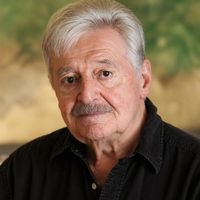
Peter Sculthorpe
Peter Sculthorpe (1929–2014) was a Tasmanian-born composer whose orchestral and chamber music drew the Australian landscape, neighbouring Asian traditions and Indigenous materials into a clear, personal language. He wrote extensively for strings, piano and voice.

Goldner String Quartet
The Goldner String Quartet plays Peter Sculthorpe's complete string quartets with the authority of an ensemble totally inside the music: precise, tonally varied, and alive to landscape, ritual rhythm and sudden cascades of harmonics.
Tracks
- i. Sun Song (Estatico – Più mosso) 2:52
- ii. Chorale (Con pietà, con sordino) 1:52
- iii. Interlude (Risoluto – Calmo) 2:58
- iv. Chorale (Con pietà, con sordino) 2:11
- v. Sun Song (Estatico – Più mosso) 3:16
- i. Deciso – Ancora deciso – Deciso 5:20
- ii. Liberamente – Poco estatico – Estatico 9:09
- Hill-Song No. 1 Peter Sculthorpe 2:46
- Hill-Song No. 2 Peter Sculthorpe 3:08
- Earth Cry (arr. for string quartet) Peter Sculthorpe 10:59
- Little Song (from String Quartet No. 1) Peter Sculthorpe 1:18
- To Meadows (from String Quartet No. 3) Peter Sculthorpe 2:32
- Pastorale (from String Quartets Nos 3 & 4) Peter Sculthorpe 5:03
- Prologue (from String Quartet No. 5) Peter Sculthorpe 3:01
- Morning Song (arr. for string quartet) Peter Sculthorpe 3:48
- Autumn Song (arr. for string quartet) Peter Sculthorpe 3:01
- Saibai (arr. for string quartet) Peter Sculthorpe 4:10
String Quartet No. 10 Peter Sculthorpe
String Quartet No. 11, Jabiru Dreaming Peter Sculthorpe
Performers
- Goldner String Quartet · ensemble
- Dimity Hall · violin
- Dene Olding · violin
- Julian Smiles · cello
- Irina Morozova · viola
Contributors
Liner Notes
Graeme Skinner
Graeme Skinner writes the annotations that turn Tall Poppies recordings into fully armed listening: texts, contexts and sharp musical argument for everything from Mozart’s rude canons to Sculthorpe’s complete string quartets.
Where to listen
Peter Sculthorpe: The String Quartets, Vol. 2 is available for streaming through Apple Music. It can also be purchased through the iTunes Music Store.
Peter Sculthorpe: The String Quartets, Vol. 2 is available as a CD. It can be purchased online through Buywell Music or the Australian Music Centre which both offer online ordering.
Product details
- Catalogue number
- TP090
- Total playing time
- 67 minutes 24 seconds
- Producer
- Belinda Webster
- Recording Engineer
- Belinda Webster
- Venue
- The Band Room at Victoria Barracks, Sydney
- Credit
- Graeme Skinner
- Release date
- 12 May 1997
- Label
- Tall Poppies
- Musical work
copyright - © 1997 Tall Poppies Records
- Sound recording
copyright - ℗ 1997 Tall Poppies Records
- Category
- Australian Classics
- Genres
- Contemporary Classical, World & Cross-cultural
- Barcode
- EAN 9399001109029
Related recordings
Peter Sculthorpe: The String Quartets, Vol. 3
Tall Poppies presents this third volume of Peter Sculthorpe’s string quartets as a tribute on the occasion of his 80th birthday in April 2009.
Nigel Westlake: The Hinchinbrook Riffs
Tall Poppies presents The Hinchinbrook Riffs: five chamber works by Nigel Westlake, whose amiable, approachable style has won him a wide and loyal audience in Australia and beyond.
Musica Viva: 60th Anniversary, Selected Commissions 1975–2004
This disc marks sixty years of Musica Viva Australia’s work commissioning Australian chamber music. Since 1945 the organisation had helped bring nearly a hundred new works into being, building a distinctive national repertoire. A full list of those commissions is included with the CD.
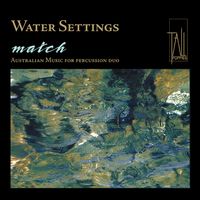
Water Settings: Australian Music for Percussion Duo
Match is a new Australian percussion duo featuring two of the country’s finest players: Daryl Pratt, Head of Percussion at the Sydney Conservatorium and a prolific composer, and Alison Eddington of Synergy Percussion. Most of the programme is by Pratt.
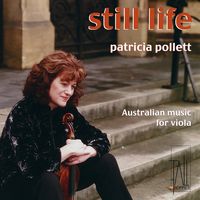
Still Life: Australian Music for Viola
This is the third solo viola disc on Tall Poppies, and one of the few such albums ever issued in Australia. Patricia Pollett is widely regarded as among the country’s finest musicians, and the violist who has done most to draw new works for the instrument.
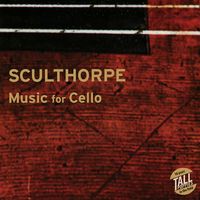
Peter Sculthorpe: Music for Cello
The cello has been a major expressive tool for Sculthorpe throughout his career. Parting was conceived in 1947 and waited forty-eight years to appear in this form. The 1959 Sonata lay dormant after its premiere; its material later became the Sonata for Viola and Percussion.